On perception of noise in the classroom
Posted on | July 23, 2010 | 1 Comment
My first English teaching job was in a primary school. I still have nice memories of that time as I learnt a lot there – including the lesson from the incident that I’m about to tell you about.
It happened in the spring of 1990, my first school year there. We were doing a speaking activity; the kids were in pairs – I don’t remember the exact details but it was something in connection with a picture (I’ve always liked using a lot of pictures). If you’re an English teacher, you can easily picture this familiar image: pairs of kids turning towards each other talking, with a teacher crouching over one pair, listening on. I must admit I was pretty pleased with the way things were going as it was our first year together and it was not that easy to get them to talk, but this task seemed to be working very well.
At this moment, the principal entered. I didn’t notice him; neither did the kids. We only looked up when he said: “I thought there was no teacher here.” I assured him I was there – then he asked me to see him afterwards. Later, in his office, he said: “I heard a lot of noise coming from your classroom when passing in the corridor, that’s why I went in. Can’t you keep order and have them remain silent?” I think my response surprised him: “I’ve been working hard for seven months to get them to talk and I’m glad you noticed the result, thank you very much.”
A moral dilemma for ELT materials writers
Posted on | May 18, 2010 | 1 Comment
For reasons that will become clear very soon, I’ve changed all the factual details in this post.
A few days ago I received an e-mail with a rather disturbing subject line: “Please don’t use the circumstances of my father’s death in your exercises”. The sender explained that he felt it was “cruel and unkind for his family and particularly his children”.
Incidentally, the said exercise was not online on any of my sites (and had never been), but this is not the point, as I was responsible for creating that exercise (a cloze test, to be precise). Years ago I sent it to a mailing list for English learners and somebody decided to post it on a website belonging to a school in one of the former Soviet republics. The page (and the whole site) had no contact information except for my name so it was reasonable on his part to assume that I had put it online – but I hadn’t. Actually, I think it was copyright violation on the school’s part – not that it matters, really.
I apologised to the sender and promised to change the names in the exercise – but that’s when I realised that I didn’t actually have it online. I explained to him that I have nothing to do with the site that published my exercise and I can’t even contact them. Unfortunately, he said I was missing the point and I shouldn’t have created the exercise in the first place and called my choice of text ”rather insensitive” and “somewhat morbid”. Let me make it clear that the article (taken from a local newspaper in his country) was not about the sender’s father; it dealt with the person who was found responsible for his suicide in a hospital. The 500-word article mentioned his father’s name once and that he was a patient at that hospital – in half a sentence. No details about the suicide or the circumstances were mentioned. The tone of the article was completely non-sensationalist in style; it gave a matter-of-fact overview of the events and concentrated on the moral and legal consequences. The sender came across the page when searching for his father’s name plus the name of his town (he shares a name with an actor so without the name of the town this 17-year-old story never comes up).
Still, I felt ashamed, as it was never my intention to hurt anybody’s feelings, especially in connection with such a tragic event. And my dilemmas start here…
In the future, if I change the names in articles like this, how do I make sure that those made-up names don’t belong to living people, who might equally (or even more!) be offended? Do I make up totally nonsense names? That would make the text look ridiculous. Do I change the names to AA and BB? That would ruin the language. Do I replace the names with references (“the manager”, “the victim”)? That would change the style and language of the original article and would make it sound unnatural.
And where do we draw the line when choosing potentially sensitive texts to work with? Of course, this can only be decided on a case by case basis – everything depends on your perceived audience and your teaching goals. But when creating exercises for online publication, where theoretically the whole world is your audience, should we completely refrain from using anything that might be controversial in this respect?
Frankly, before this incident, I only had my students in mind when deciding whether a text was appropriate or not. Now it seems that maybe we should take another factor into consideration. Or should we? This person was obviously looking for sites dealing with his father’s suicide 17 years ago. Why now – I don’t know and it’s probably none of my business.
Oxford Advanced Learner’s Dictionary freely available online
Posted on | April 29, 2010 | No Comments
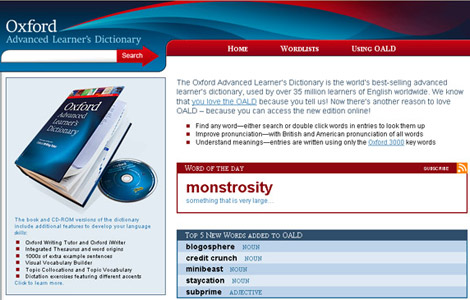
An exciting new offer from Oxford University Press: the latest (8th) edition of their Advanced Learner’s Dictionary is now freely available online at oxfordadvancedlearnersdictionary.com.
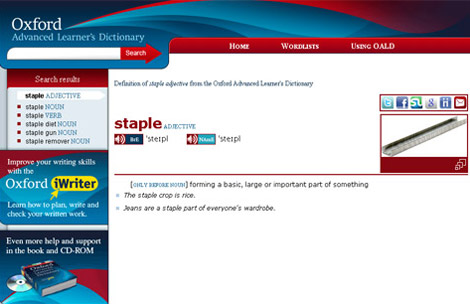
The elegantly simple design lets your students focus on the main thing: the search box in the top left corner. On typing staple and clicking on the Search button, this is what you get:
From the box on the left choose which staple you’re interested in – as you can see, some headwords have picture illustrations too (funny though that the image of staple as an office tool is shown for the adjective staple), and you can always listen to the pronunciation in both British and American English, plus you get the phonetic transcriptions.
Most (if not all) words come with sample sentences, and when necessary, the definitions are accompanied by a special note; in this case, for staple: “only before noun”.
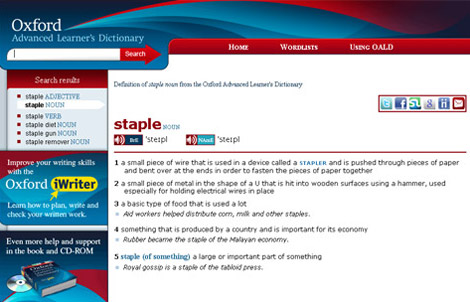
Above is a screenshot of the the staple (noun) page – you pretty much get what you can expect: clear definitions and carefully chosen sample sentences.
A very useful feature of the site is the Oxford 3000TM – a list of the most important 3000 words for learners.
You can also subscribe to their Word of the Day feed and get a new word in your reader every day.
Of course, there is still a lot left out that you will only get if you buy the printed dictionary and its accompanying CD-ROM but you can’t blame Oxford here – this online dictionary is such excellent value that we can only thank them for making it freely accessible.
IATEFL LT SIG Virtual Pre-Conference Event
Posted on | February 23, 2010 | No Comments
From the IATEFL LT SIG:
The IATEFL LT SIG would like to invite you to join the ‘Virtual Pre-Conference Event’ (VPCE) at http://iatefl-ltsig.ning.com/
There are 6 weeks left before the 44th annual IATEFL conference in Harrogate, UK and in the run-up to the conference, we have decided to hold a ‘Virtual Pre-Conference Event’(VPCE)
The focus of the Pre-Conference Event (PCE) this year at the IATEFL conference is to consider where we are in the field of learning technologies and language learning and where we might be going. Have we reached a time when learning technologies are a ‘normalised’ part of our practice or is there still some way to go? Are there any predictions we can make about the future?
We have asked three people – Stephen Bax, Scott Thornbury and Mark Pegrum – to help us on April 7th with short focused presentations during the day at various points to seed the debate. Stephen and Scott will be in Harrogate, Mark will be online.
Before then, the VPCE will be examining where we are now, with 6 weeks of discussions and practical ideas involving on how to use Web 2.0 tools in your classroom.
Call for submissions for an eBook on Second Language Teaching and Learning with Technology
Posted on | February 22, 2010 | No Comments
From Sylvie Thouësny:
Call for submissions for an eBook on Second Language Teaching and Learning with Technology
Editors: Sylvie Thouësny and Linda Bradley
Linda Bradley and myself (Sylvie Thouësny) are proposing an edited peer reviewed eBook focusing on second language teaching and learning preferably using online technology. Online technology here refers to web-based computer applications and Internet technology in all its forms, including, but not limited to for instance:
- Social networks
- Videoconferencing
- Shared online video
- Virtual worlds
- Web 2.0 technologies (podcasting, wikis, blogs, etc.)
Targeted to young researchers, having just completed –or nearly completed– their PhD, the eBook will be digital rights management free and accessible online free of charge.
If you are a young researcher, we would like to invite you contribute to this eBook. Please send a 500-word abstract to ebook@icall-research.net by the 31st of March 2010, along with your name, affiliation and email address. The abstract should be submitted electronically as either a Rich Text Format (.rtf) or Microsoft Word (.doc) file. Abstracts and manuscripts will be peer reviewed to ensure that the articles to be published represent the best scholarship currently available.
Reading Committee:
- Dr. Françoise Blin, Dublin City University, Ireland
- Linda Bradley, University of Technology, Sweden
- Graham Davies, Emeritus Professor of Computer Assisted Language Learning
- Dr. Agnes Kukulska Hulme, The Open University, UK
- Dr. Meei-Ling Liaw, National Taichung University, Taiwan
- Dr. Hans Paulussen, K.U. Leuven Campus Kortrijk, Belgium
- Dr. Peppi Taalas, University of Jyvaskylä, Finland
- Sylvie Thouësny, Dublin City University, Ireland
- Dr. Monica Ward, Dublin City University, Ireland
Deadlines and important dates:
- Submission of abstracts: March 31, 2010
- Decisions to authors: May 31, 2010
- Manuscript file due (chapter draft): August 31, 2010
- Manuscript file due (final draft): November 30, 2010
Any questions on the eBook project? You are more than welcome to contact us at ebook@icall-research.net, or visit http://icall-research.net/ebook.php
We look forward to hearing from you!
Sylvie Thouësny and Linda Bradley
Free 6-week online session on using technology in ELT
Posted on | January 10, 2010 | No Comments
Call for Participation for TESOL’s Electronic Village Online (EVO)
http://evosessions.pbworks.com/Call_for_Participation2010
These workshops are run by EVO, Electronic Village Online, which is part of the American-based TESOL – Teachers of English to Speakers of Other Languages.
There is nothing quite like these workshops – visit the site to see the range. They are thoroughly international, run by experts – thoroughly recommended.
The best of the ELT blogosphere 2009
Posted on | December 27, 2009 | No Comments
This will be a very subjective and incomplete list of the blog posts I found the best (whatever that means) in 2009. I had no criteria or concept; the list is simply based on my impressions. Please feel free to add your favourite posts in the comments section.
So, these are the posts that I particularly enjoyed in 2009, in no particular order:
Burcu Akyol: My (Professional) New Year’s Resolutions
A truly inspiring list – could apply to all teachers.
Jeremy Harmer: Trouble in twitterland, bullets in the blogosphere
A thoughtful and thought-provoking piece on a recent debate sparked by Gavin Dudeney here on egos and much more.
Gavin Dudeney: The Luddite Codex
An excellent rebuttal to those opposing the use of technology in ELT – brilliantly argued.
Scott Thornbury: D is for Drills
Scott’s first post on his new blog, and what a way to start! Also, make sure you read the comments too – they’re as valuable as the original piece itself, as is often the case with great posts.
Tamás Lőrincz’s guest post on Ken Wilson’s blog: A tribute to the real unsung heroes
I can only repeat what I read in the comments: a touching post.
Lindsay Clandfield: Six activities with camcorders
Original, useful, practical, inspiring.
Tamás Lőrincz: What’s your story? The start of a love affair
Tamás keeps on coming up with touching posts.
Gavin Dudeney’s guest post on Lindsay Clandfield’s blog: Six attitudes to technology
Once again, Gavin takes a critical look at some false assumptions on the use of ICT in ELT. And once again, read the comments by all means – isn’t it interesting that the first negative comment accuses him of making up strawmen? The exact same argument was used against my similar post by a different colleague.
Ken Wilson: “Who CARES what English people have for breakfast?” – My contribution to the culture debate
The title says it all – thoughts on teaching culture; again, read the comments section as well.
OK, this list will have to end here, I’m afraid. It took me well over a day to write this short post because I kept on reading instead of writing (not a bad thing, actually). When I began, I had a vague idea of which posts I wanted to include, but of course I re-read many more, followed links… you know how it goes. So the list remains incomplete and unfair, as there are no posts included from Vicki Hollett, Sara J. Hannam, Stephen Downes, Graham Stanley, Nik Peachey… and many more.
Please help remedy this situation and post a link to your favourite ELT blog posts of 2009 in the comments.
Create animated cartoons in seconds
Posted on | November 29, 2009 | No Comments
OK, this might not be the greatest animated cartoon ever created but it took me about five minutes, starting from scratch:
Your students will need less time and create much better animations too, no doubt. The possibilities are endless – there are so many things you can do with it you actually have to concentrate not to lose focus and get lost while exploring all the options.
You can get your students to create stories based on the topic you’re dealing with or use it in any other way, in groups or individually – you can even make it into a competition and they can vote on the best pieces. Just exploring the options and learning to use the site will be useful in itself – they will have a reason to read for information if they’re interested in creating animations.
Visit goanimate.com to create an account and create your own stuff. I only have one slight misgiving about the site: they use pretty heavy marketing tactics to promote themselves – but, hey, they have to make a living.
Vienna ConneXion 2010
Posted on | November 13, 2009 | No Comments
Teaching English in the Twenty-First Century
Eleventh Biennial TEA Conference
Plenary speakers include:
Professor Henry Widdowson
LSI Mag. Gabariel Friedl-Lucyshin
Mark Fletcher
Andrew Wright
Date: 23-25 April 2010 (Friday – Sunday)
Venue: VHS Favoriten
Arthaberplatz 18 1100 Vienna
Tel: +43/ 732/ 24 59 28
Fax: +43/ 732/ 24 59 28 – 21
Visit the TEA website for more information or download the Conference Guide.
Myths, misunderstandings, misconceptions and more about ICT – Part 1
Posted on | October 9, 2009 | 40 Comments
There are so many myths, misunderstandings, false assumptions and other misconceptions concerning using technology in the foreign language classroom that a meaningful exchange of ideas is often impossible because people on the two sides simply have no common ground. Opponents of ICT surprisingly frequently make value judgements and condemn technology on a moral or psychological basis, which makes a healthy debate impossible. This stance takes the whole issue out of the realm of education and puts advocates of ICT in a position where they have to defend themselves right from the start – this is an unacceptable basis for a professional discussion.
Also, ICT is often dismissed as a passing fad. Again, this is an unsuitable starting point. It is all very well when somebody believes they are clairvoyants and can reliably predict the future, but we should be talking about the present here. It’s very convenient to want to discuss the future since nobody can have any concrete evidence about it, but it is only an easy way out of a discussion based on observation and proof. We should concentrate on the present, and it is safe to say that technology is very much here with us now, so let’s accept this fact instead of saying that it will go away so why bother.
With this in mind, let me try and clarify a few things that I believe hinder understanding concerning using technology in the classroom.
Another new method? No, thanks
A lot of teachers seem to be suspicious of ICT because they feel this is a fancy new method being sold to them. Well, no. ICT is just a tool, not a method. A relatively new tool, and perhaps more complex than a cassette recorder or the OHP, but still a tool. Of course it is true that using a new tool will inevitably change your teaching – but are you sure that you want to keep on teaching in the same style for 30-40 years? ICT is not a method – just like the communicative approach is not a method either: it is an approach.
What often gets overlooked that it is very much in line with the old tradition of using whatever we have available for teaching – the cassette recorder and the OHP were not invented for language teaching purposes; we just grabbed them and used them nevertheless. Similarly, if you give a good teacher a bag of potatoes, he or she will be able to use it for teaching English – so why not do the same with technology too once it’s available?
I teach communicatively, I have no need for computers
If you really believe in the communicative approach, then ICT is for you. There are a lot of similarities between the two notions. The communicative approach is based on the observation that language is used for communication (should be a no-brainer, really). The idea of using computers in language teaching is based on the observation that our students live in a digital world (again, this shouldn’t come as a surprise either). This digital world is all about communication – and real communication, not simulations that we sometimes have to resort to in the classroom. Your students can exchange views and ideas with others around the globe about the topics that genuinely interest them – would this be possible without the net? And this is just one example – the possibilities are truly limitless.
But if the realisation that we all live in a digital world is not reflected in your teaching, you will not be teaching your students, but their “school personas” instead. Schools today are often so disconnected from the realities of the students’ world that kids (mainly unconsciously) develop a new personality that they “send to school” – this is reflected in the frequently quoted sentence “I have to power down when I go to school”. Schools used to be one of the main information sources – they no longer are. This old video (created more than two years ago, that’s very old on the net!) was a huge hit, with close to 3.5 million direct downloads and probably tens of millions of viewers – and we still have to convince teachers that they cannot go on living in a world that no longer exists?
Technology distances people
Again, this is a classic example of the problem of answering a question without actually asking it. A long time ago someone came up with this completely unfounded statement and it has been parroted ever since, without actually thinking it over. I can only compare this mindless automatism to the well-known “truths” about our brain working at 10% capacity only (or 5%; figures vary; geniuses are believed to be able to use up to 20%), or dissolving a child’s tooth in a glass of Coke overnight (easily proven untrue, but nobody ever cares to perform this simple experiment, just passes on the urban legend without any criticism).
Why would technology distance people? Do you have a mobile phone? There are almost 11 million mobile phone numbers in use in Hungary, a country of 10 million, and the ratio is similar in all developed countries. Why? Because mobile phones are so convenient and make keeping in touch with others so easy. Before mobile phones, when you arranged to meet someone in the evening but found out later in the day, away from home, that it would be better to change either the place or the time of the meeting, you had to find a phone and hope to be able to reach the other person – often it was so hopeless that you didn’t even try. Now it’s not a problem. Or have you ever phoned your husband or children instead of trying to find them when you went your different ways in a shopping mall? Or think of correspondence before you had e-mail. How many “snail mail” messages (formerly known as “letters”) did you write a week? Or even in a month? And how many e-mails do you now write per day? Ten times as many? Probably twenty times as many? Where is that distancing effect then? Just the opposite is true. Technology brings all of us closer instead of alienating us. Frankly, claiming that anything new is dangerous is so lame that I feel embarrassed to have to disprove it. Facebook, Skype, YouTube… the list is endless. So much for distancing…
Technology always breaks down, I just can’t rely on it in my lessons
Not this one, please… So basically you’re claiming that there are things in life that don’t always work the way they’re supposed to? Now that’s new. You shouldn’t drive a car or even use a toaster – if these break down, you’re bound to be in greater trouble than in your lesson when you find that there’s no net access. Also, I don’t know if youhave noticed but anything non-technical can go wrong just as well. No matter how thoroughly you prepare, there will always be aspects that you can’t control. Or are you so lucky that you’ve never had a brilliantly designed lesson go to complete waste because the kids were just in a bad mood or felt too tired, because you suddenly had a splitting headache, because there was a fire drill… ? Even if you say that the chances of something technical going wrong are higher (would be hard to prove, you must admit), you can and should have a backup plan for lessons requiring computers so that when technology fails, you have something to fall back on. Honestly, I have always felt that this “technology never works” slogan is just a poor excuse. Being afraid of anything new is a personality trait some people have, I’m aware of this fact. But we as teachers cannot afford this luxury, sorry.
This video repeats some of the same messages as the one embedded earlier, but I believe it has a powerful message.
Please comment.
To be continued…
keep looking »